Furious Clarity
True change starts not by relying on compromised political elites or uncaring corporate institutions but instead by forging community and solidarity out of frustration

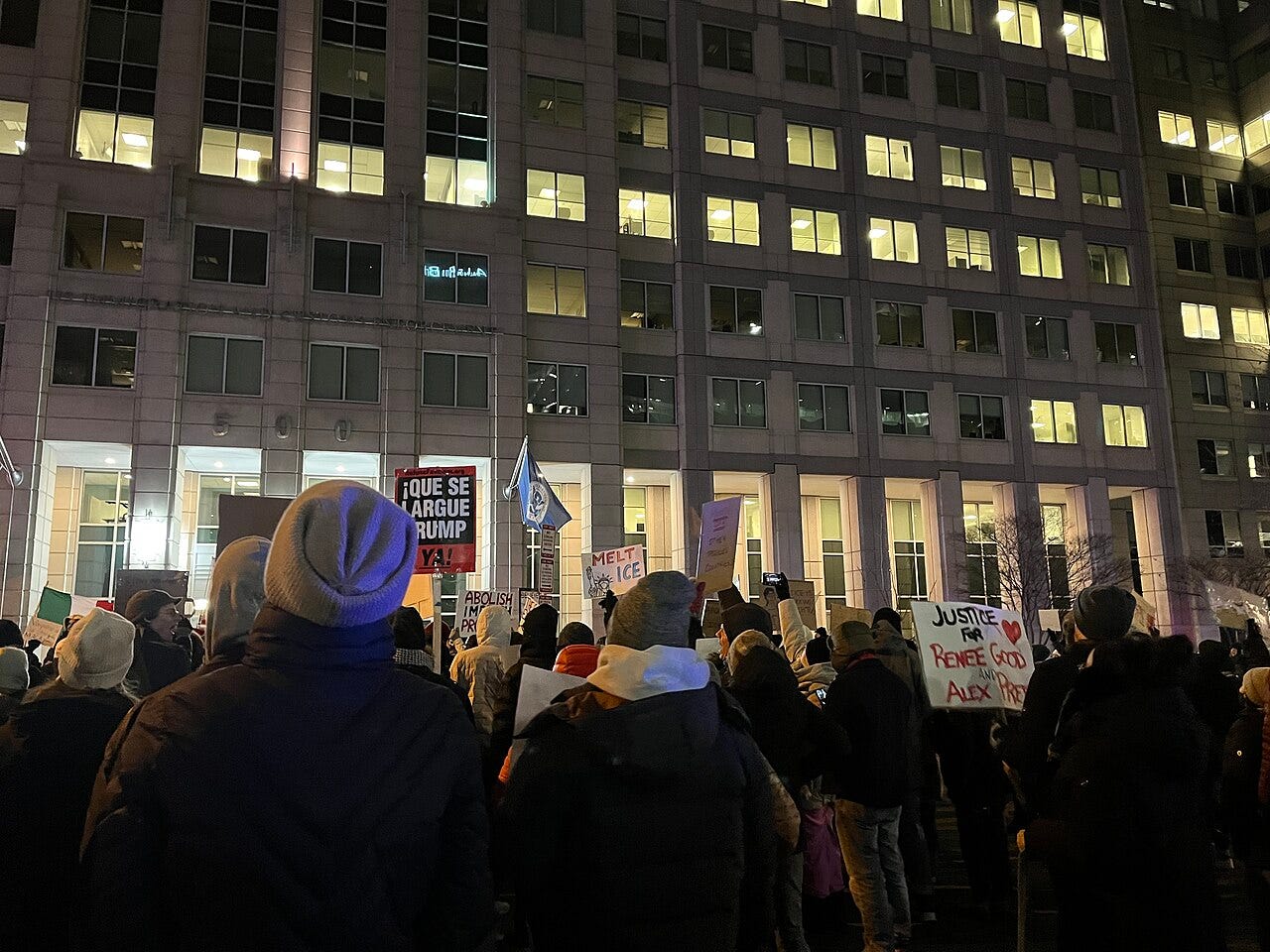
Protestors in front of Immigration and Customs Enforcement (ICE) headquarters, Washington, D.C. January 24, 2026. Source: Wikimedia Commons
To be well-informed about the world today is to seemingly condemn yourself to veering between perplexed anger and puzzled sorrow.
Amidst the incessant cacophony of bad things growing worse, it feels easier to give up and succumb to the notion that nothing can be done. In fact, it is easier; at least on an individual level.
But surmounting the personally convenient in favour of the publicly constructive is at the heart of the human spirit. There are no freedoms we currently enjoy that were gifted to us by our oppressors, regardless of what revisionist mythmaking would have you believe. Every right, every triumph, every victory was earned through protest, movement, revolution.
Constructive rage is more than simple anger. One doesn’t have to look far to see what crude mockeries of justice are spawned from directionless fury. At best, it is unpleasantly self-serving; at worst it is a cause of immense suffering,
To be politically instructive, anger must be tempered with empathy. The radical poet Audre Lorde described how anger transformed thusly became a “liberating and strengthening act of clarification.” Anger directed towards injustice, aimed in such a way to be generative, is as capable of as much good as its baser counterpart is of evil.
When directed towards a group, an Other, rage serves as little more as a tool of oppression. Indeed, much of the rise of fascism across the world has been predicated upon harnessing this solipsistic fury by providing scapegoats to beat, brutalise, and bury.
Lordean rage – that is, fury directed towards the causes and support structures of that very same justice - is societally productive. It provides the impetus to get things started; to join that organisation, to petition that representative, to attend that protest. To stand up for your community and people.
As individuals, we have little say or control of things. The monopoly on violence is already held by the state – which is to say attempting to direct violence is often as practically ineffective as it is morally depraved.
The enemy is not individual; it is systemic. It is the racist power structures that jeer as Israeli soldiers ethnically cleanse Palestinians. It is the unjust stereotypes that remain mute when militias violate Sudanese civilians. It is the capitalistic greed that grows fat when corporations strangle democratic conventions for the sake of profits.
And it is the ways in which they all intersect - like how weapons, training, and technology used by the IDF to exterminate Gazans are sent back to the US to better train the attack dogs of the state to assault civilians - that create a tapestry of brutality.
But unravelling these bloodstained threads lies in creating our own kinds of systems. It lies in interweaving the rage felt at the injustices of the world and those who author them with the love needed the heal the wounds inflicted upon our societies.
In 2008, during a near-freezing evening in Pittsburgh, a tired yet frenetically optimistic Barack Obama clambered up to the podium. Speaking to a throng brimming with the almost fissile excitement that engulfs those suddenly aware that the unbelievable is suddenly becoming tangible, he ended his campaign speech by emphasising how politicians do not negate the need for activism; “don’t think for a minute that power will concede anything.”
A clear reference to the 19th century abolitionist Frederick Douglass (who, in 1857, said “…power concedes nothing without a demand. It never did and it never will”), this allusion seemingly signalled that this potential President understood a different sort of political history than his opponents.
Hindsight, however, compels us to rethink Obama’s legacy. He was a textbook drone-strike-authorising, Wall-Street-defending, carceral-authority-funding neoliberal leader. Douglass’ radical words he may have adroitly adopted; but Douglass’s radical politics he did not.
But perhaps that was also demonstrated in Pittsburgh. Obama’s reference was akin to screaming “power is bad!” because he omitted the most critical part of Douglass’ assertion; that struggle, with all the discontent that entails, is the only way to ensure progress.
“Those who profess to favor freedom and yet depreciate agitation,” said Douglass, addressing a crowd on the twenty-third anniversary of the British Slavery Abolition Act, “…want crops without plowing up the ground, they want rain without thunder and lightning…They want the ocean without the awful roar of its many waters.”
Listen close enough, and you may glean words contained within the awful roars of Douglass’ ocean. A firm clarion cry amidst the roiling maelstrom: enough is enough.
It is the spark of social protest. A bright yet fragile ember that can be stoked to achieve a great many things in defence of the universal dignity of humanity.
Unlearning the myths inculcated by systems that prefer their societies to be uncommitted and unbothered is the first step. Freedom is granted not through the largesse of the oppressor but through the moral clarity of those who agitate against them.
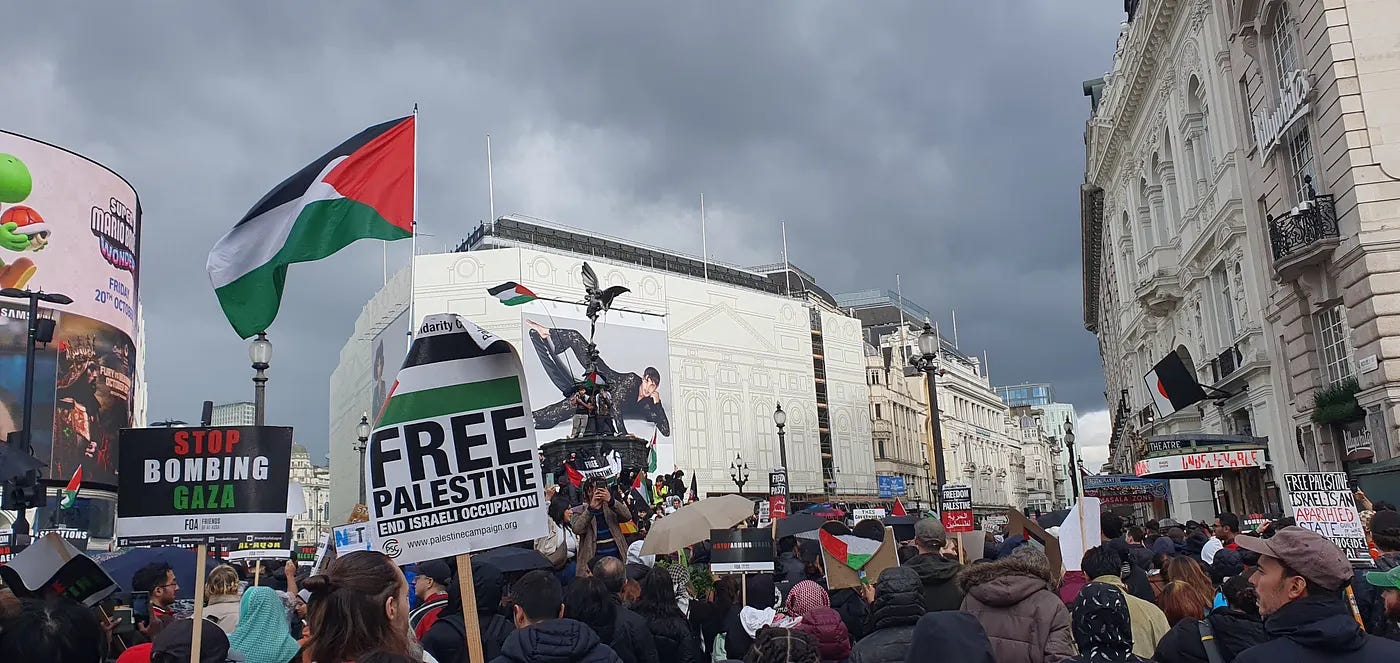
Protesters marching in London, 21st October 2023, calling for an immediate ceasefire and end to the Israeli occupation of Palestine. Soruce: Author.
From Haiti to India to Palestine; from Occupy Wall Street to Tiananmen Square to Shaheen Bagh; from an Arab Spring to a Freedom Summer to a Winter Revolution. Freedom rings loudest when shouted in defiance.
For those on the other side, this noise is an unpleasant irritant; a shrill pollutant that vexes their societally cannibalistic privilege. Those responsible are castigated as malcontents and troublemakers; a nurse gunned down by ICE thugs is labelled a “domestic terrorist,” children murdered by Israeli genocidaires are accused of being collaborators.
This is not new. Suffragettes engaging in property damage in 1910’s England in their fight for equal rights were described as “hysterical, crazy, and irresponsible” – just as colonised nations protesting for their sovereignty were deemed unfit to self-govern, and minorities demanding equal rights in a post-World War international order seen as uppity irritants.
But the anger and frustration of the oppressed, and those marching in solidarity with them, is not the problem. The fault lies with those who ignore them. Those who refuse to listen, literally plugging their ears in the face of monstrous evil; those who fail to empathise, preferring to flabbily regurgitate the words of the oppressor.
Building a better world starts by remembering the simple truth about equality that elites of all stripes would like you to forget.
Sternly-worded letters did not garner freedoms. Protesting for them did. Bland individualistic statements did not grant liberation. Collective agitation and action did. And liberty did not come from politicians safely ensconced in their estates; it came from people of all creeds marching in the streets, united by a single belief: enough is enough.
Power concedes nothing without a demand, after all.